
Read What Van Buren County Deed Records Transfer
Every recorded deed names the parties, describes the land, states the kind of conveyance, and carries a recording locator. It sits in the Register of Deeds index beside mortgages, releases, easements, liens, plats, and similar instruments. Those records do not all transfer the same interest, though, so read each one for what it actually does.
| Deed type | What it does | Common record use |
|---|---|---|
| Warranty deed | Conveys the grantor's interest with stated covenants | Document an ordinary sale |
| Quitclaim deed | Conveys whatever interest the grantor has without broad warranties | Family, estate, or title cleanup transfer |
| Personal representative or fiduciary deed | Conveys under estate or fiduciary authority | Follow a probate-related transfer |
| Sheriff or tax deed | Records a transfer produced by a statutory proceeding | Trace distressed-property history |
A mortgage or lien records a claim, not a new owner. To know whether that claim still binds the land, read the full instrument and any later releases.
Search Van Buren County's Tyler Deed Index
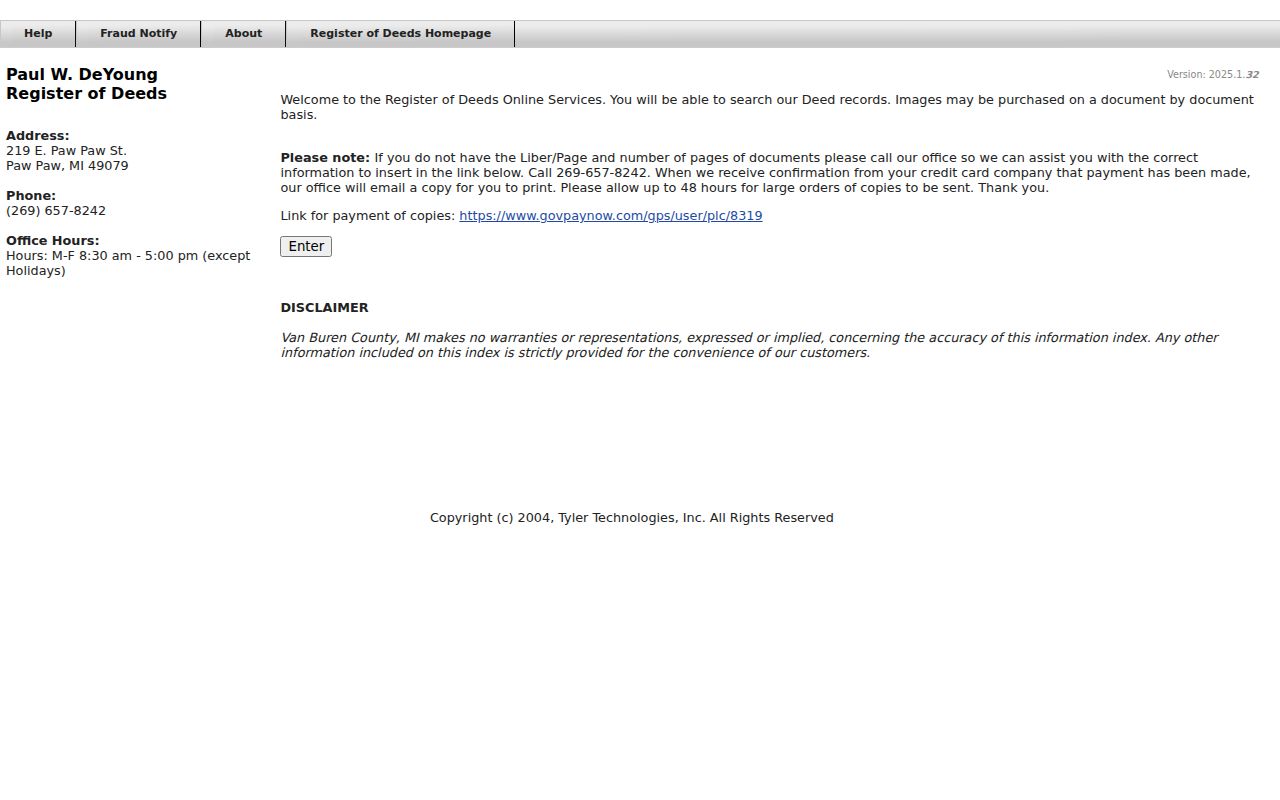
The Register of Deeds QuickDocs route opens the county's Tyler EagleWeb index. New users register briefly before searching. The index works well for names, recording dates, document types, and instrument locators. Document images are purchased one at a time. The county's guest-search page displays the public entry point along with its paid-image notice.
Copy the complete index citation before leaving a result. That citation ties the search hit to a copy request, so losing it means searching again.
| Search field | Purpose | Technique |
|---|---|---|
| Grantor | Party transferring an interest | Try individual, trust, estate, and entity variants |
| Grantee | Party receiving an interest | Start here for an acquisition deed |
| Document type | Narrow a broad name result | Do not assume every lien is labeled alike |
| Recording date | Limit the period | Allow time around the expected closing |
| Liber/page or instrument | Open a known citation | Copy every component |
Walk the Van Buren County Grantor-Grantee Chain
Start with the most recent likely deed. Work backward through party names from there. A Van Buren County chain can branch through probate, a trust, a foreclosure, a correction, or a parcel split, so the legal description matters as much as the surname at every step.
- Find the current acquisition deed with the current owner as grantee.
- Read its grantor, legal description, recording date, and locator.
- Search that grantor as a grantee in an earlier period.
- Compare the land description before adding the earlier transfer.
- Repeat, then move to books, microfilm, or archives when the online trail ends.
- Grantor
- The party conveying an interest.
- Grantee
- The party receiving an interest.
- Chain of title
- The ordered sequence of instruments affecting ownership.
- Liber/page
- A book-and-page citation used to retrieve a recorded document.
Liber 924 and 925 Split Van Buren Copy Work
Van Buren County splits copy work at the liber line. Records in Liber 924 or lower follow the older-copy payment route. Liber 925 and higher run through the searchable index with automatic download. The split is a workflow rule rather than an announced date boundary. The county publishes no earliest year for online deed records searching. For an older chain, ask the Register where the direct or reverse index is held. Also ask where the deed book or microfilm sits. That beats guessing a cutoff year. Note: Keep the party-name search and the liber/page citation, so staff can reproduce the request.
Get a Van Buren County Deed Online or Offline
An online user can find an index entry and buy the image. Anyone holding a citation has more options. Contact the Register for a plain or certified copy. Use the appropriate county payment route. You can also visit the Paw Paw counter. Or mail a request with enough detail to identify the record. The Register of Deeds sits at 219 E Paw Paw Street, Suite 102, Paw Paw. Its listed phone is 269-657-8242. Put the names, document type, approximate date, parcel or legal description, and the full instrument or liber/page reference in every request. Ask the office for the current total and delivery method. The right path depends on the record.
A complete citation saves a round trip. Give staff everything up front.
Recorded, not guaranteed. The index shows filed instruments; it is not a title opinion and does not rule out an unrecorded interest.
Van Buren County Does Not Search Easements for You
The county FAQ is blunt. Staff do not perform easement searches. They do not prepare legal documents, create abstracts, or give legal advice. That work falls to the searcher. Run grantors and grantees through the index, then check subdivision plats, deeds, and dedicated easement instruments. A legal description and a book/page clue often beat the current street address for this purpose. For a boundary or access dispute, a title company, attorney, or licensed surveyor may need to connect the recorded language to the ground. County GIS can orient the search. But a drawn line is not the easement, and the map decides no legal rights.
Recording Requirements Shape Van Buren Deed Records
The Register's recording guidance calls for legible pages, required signatures and acknowledgments, return information, the drafter's name and address, and a sufficient legal description. A transfer after a death can require proof of death or proof of authority. Rejection may expose a missing formal element. It is never a judgment about title. Review the official recording requirements before submitting any instrument. Transfer taxes, exemptions, and other details turn on the document itself, so rely on the county's current instructions rather than an old deed's treatment.
Follow a Probate Transfer into Van Buren Deed Records
Probate explains authority or distribution. The recorded deed finishes the land-record trail. Search MiCOURT for a case lead where available, then request the official probate file from the court. Look for an order, letters of authority, an inventory, or a fiduciary action naming the property. Next, search EagleWeb for a personal representative, estate, trust, heir, or receiving party. Compare dates and legal descriptions across both files. The Archives of Michigan holds older Van Buren probate journals and related series, and the County Clerk's genealogy resources can support an heir or property-history project. Neither substitutes for the deed itself.
Historic Van Buren County Land Books Fill the Gap
Pre-digital research in Van Buren County draws on the 1873, 1895, 1906, and 1912 plat books, historic PLSS survey field notes, and recorded subdivision plats. Archives holdings add mortgage, real-estate sale, assessment, tax-sale, and probate series. Each source answers a different question. Cite every one by repository, series, date, and locator.
The 1901 courthouse cornerstone and the 1903 dedication mark a shift in the physical setting of county record work. The old courthouse survives as Paw Paw Village Hall. Current Register services stay centered in Paw Paw. Physical indexes still matter whenever the web trail runs thin.
Fraud Notify Supports Van Buren Deed Monitoring
The Register's Fraud Notify service watches for a matching name. It triggers whenever a new instrument gets recorded. An alert is only a heads-up. It never blocks a filing or proves that fraud occurred. To evaluate one, pull the actual instrument. Check the legal description against the parcel. Call the Register or law enforcement if the facts point to trouble.
An Almena Township title-fraud episode came from an April 2026 Sheriff's report. It involved alleged liens tied to a terminated sale. That report was an allegation, never a judgment. Its real value is procedural. Watch the names on the filing and inspect the real instrument. Save the citation. Get legal advice rather than trusting an alert alone.
Recorded Plats Bridge Van Buren Deeds and Parcel History
Not every deed spells out metes and bounds. Many Van Buren County deeds instead cite a subdivision name, a lot, and a block. The Parcel Viewer can carry you back to the original plat. Switch on Subdivisions in the legend, and click the shaded feature. Then page through the "Multiple Features Selected" panel, and open the link to the original map. Michigan LARA also sells copies of state plats.
Check the plat name against the deed. Check the lot number too, along with any later splits and the current parcel number. The county Plat Board handles plat approval, while the Register keeps the recorded instrument. A planning approval, a GIS polygon, and a recorded plat are related. They are not interchangeable. Old county plat books offer names and context. But the deed-book entry still proves the transfer.
Search Van Buren Liens and Releases Beside Deeds
Stop at deeds and you can miss an encumbrance. Search the same party-name variants for mortgages, assignments, discharges, construction liens, tax liens, easements, and releases across Van Buren County records. Log each instrument with its legal description. Then tie every release to the obligation it satisfies.
Keep the roles straight. A mortgage never makes the lender the deed owner, and a release never transfers the parcel. A court judgment or a tax delinquency may live in a separate court file or Treasurer record. Names shift through estates, trusts, and entity filings, so search the index in both directions and lean on the land description to avoid merging two strangers who share a surname.
Document the Van Buren Deed Chain as You Go
Build one line for each proven transfer. Include the recording date, grantor, grantee, deed type, legal description, and liber/page or instrument number. Attach the source image or copy. Note your search date. Never fill a gap from an ownership plat, tax roll, or family story without the instrument. Label any such source plainly as a lead.
When two people share a name, check several details. Weigh spouses, middle initials, entity wording, municipality, and the land description. A correction deed fixes wording; it is not a new sale. A quitclaim passes only what its grantor actually held. The label says nothing about title quality. Estate and court transfers may need the related file to show authority.
The table exposes gaps too. The official online start year may not be published. If so, record the last digital instrument you reached. Then ask the Register for the correct older index. Guessing a start date from the parcel's age is not research.