
Read the Van Buren County Property Tax Record
Every tax search rests on two layers. One is the assessment roll kept by your city or township. The other is the county Treasurer's billing and delinquency record. County Equalization checks consistency across local units. Values, exemptions, millage, payments, and delinquent totals change on different schedules. Because of that, the parcel number and tax year should travel with every figure you write down.
| Field | What it shows | Where to verify |
|---|---|---|
| State Equalized Value | Equalized assessment, generally one-half of true cash value | Local roll and BS&A |
| Taxable value | Value used in the tax calculation, subject to Michigan limits | Assessment record |
| PRE status | Principal Residence Exemption treatment for school operating tax | Local assessor |
| Tax bill and history | Levies, billed amounts, payment entries | BS&A or Treasurer |
| Delinquent total | Amount calculated for a stated payment date | County Treasurer |
A recorded sale price is a transaction figure. It is not another name for SEV or taxable value.
Look Up a Van Buren County Tax Bill
Two routes work for a Van Buren County tax bill: BS&A Online and the Treasurer-linked AccessMyGov path. The county entry supports Address, Name, and Parcel Number searches. When an address has changed or one owner holds several accounts, the parcel number is the safest key.
- Select the correct search mode and open the matching parcel.
- Confirm the municipality, situs, and parcel number.
- Read Property Information, Tax Information, and Delinquent Tax tabs separately.
- Set the payment date when the portal offers recalculation of a delinquent total.
- Contact the assessor about value or PRE and the Treasurer about county delinquency.
The Treasurer-linked tax entry shown below is the county's public handoff.
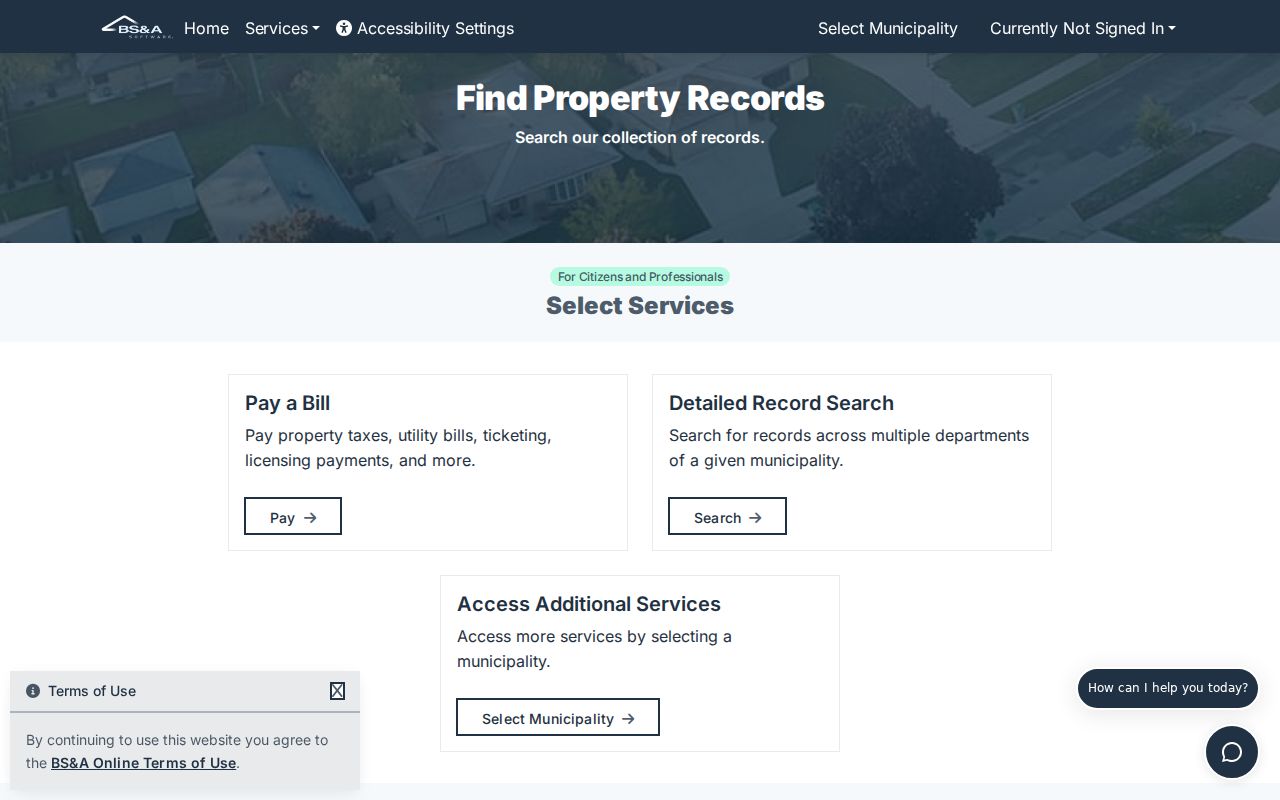
The entry point opens the account details. Each field still answers to its custodian and tax year.
Separate SEV, Taxable Value, and Cash Value
Michigan sets the terms here. True cash value means the property's usual selling price. Assessed value sits at one-half of true cash value, and State Equalized Value reflects equalization. Taxable value is the base for millage, and it stays capped until a transfer of ownership uncaps it under state rules.
- SEV
- The assessment after county and state equalization.
- Taxable value
- The value used to compute the property tax.
- Mill
- One dollar of tax per thousand dollars of taxable value.
- Tax lien
- A statutory claim arising from unpaid property tax.
Never copy taxable value to guess a selling price. For what a property is actually worth, treat the dated roll and the sale history as two separate kinds of evidence.
Property, Tax, and Delinquent Tabs Differ
A BS&A result lays out property and taxpayer details, legal description, class, SEV, taxable value, PRE, sale history, and tax history. Delinquent information sits in its own place. A Building Department tab can show up for participating units, though its presence and content vary.
| Portal area | Use it for | Do not infer |
|---|---|---|
| Property Information | Parcel identity, roll owner, class, values | Guaranteed title |
| Tax Information | Bill detail and payment history | Current delinquent payoff without checking date |
| Delinquent Tax | County-held unpaid amount | That a sale is already scheduled |
| Building Department | Participating-unit permit data when present | A complete improvement history |
Local Assessors and the County Treasurer Split the Record
Cities and townships in Van Buren County keep their own assessment rolls. The county therefore publishes an assessor list by municipality. County Equalization compiles reports, ratios, multipliers, and historical statistics. It does not replace the local assessor's parcel file. The Treasurer collects county taxes and administers delinquent real-property tax.
The July 2024 assessor list names the right local contact. That assessor answers questions about classification, taxable value, PRE status, a notice of Assessment, or Board of Review. The Treasurer handles other duties. These include a delinquent balance, a payoff through a future date, or the annual foreclosure process.
Note: A city mailing label does not prove which assessor keeps the parcel.
PRE Does Not Identify a Van Buren County Owner
Principal Residence Exemption status changes how school operating tax treats an eligible principal residence. It is not an owner field. It is not a deed or occupancy certificate. It never means every tax on the bill is exempt. Read PRE alongside the assessment year and the local unit's own record.
Timing differences creep in easily. A transfer, a move, an estate event, or a correction can leave the deed, the roll owner, the mailing address, and the PRE entry out of step. The local assessor supplies the form and evidence fitting the situation. Confirm ownership separately through the newest recorded deed.
Appeal a Van Buren County Assessment Through the Local Unit
Most assessment or classification protests start at the local Board of Review. Michigan Form L-4035 is the petition named in the county materials. It requests the parcel, classification, disputed values, requested change, reasons, supporting facts, and a signature.
Read the assessment notice and your municipality's current meeting and filing rules. Some Michigan Tax Tribunal paths require a timely local protest first. Dates are local and annual. An older notice should never be read as a countywide deadline.
Appeal window. Confirm the current local Board of Review date and petition method promptly; missing a required protest can affect later review.
Strong support can include corrected property characteristics, comparable evidence, photographs, an appraisal, or proof that the wrong parcel or classification was used.
Payment Date Changes a Delinquent Tax Total
Van Buren County's delinquent-tax system includes a payment-date field that recalculates the amount due. Interest and charges make any screen total date-sensitive. Enter the intended payment date first. Then confirm the payoff with the Treasurer before sending funds.
Current local taxes and county-held delinquent taxes can sit at different stages. This can happen at the same time. Keep the tax year, local unit, parcel number, payment date, and confirmation together. A zero on one tab proves nothing about another account or year.
Van Buren County Tax Sales Have a Separate Route
The Treasurer's tax-sale auction page points to Tax-Sale.info for the annual list, registration, bidding, and terms. A delinquent entry alone does not put a parcel in the current sale. Check the official current list and every notice.
A tax deed or foreclosure can change ownership. Bidders should still examine recorded instruments, occupancy or condition issues, boundaries, and legal risks on their own. The online property tax record is one piece of due diligence. It is not a promise about title or possession.
Historic Van Buren Assessment Rolls Add Time Depth
The Archives of Michigan county guide traces Van Buren assessment rolls back to the nineteenth century. It also covers related tax series, with assessment material spanning 1838 to 1920. Those rolls put a name in an earlier tax context. They also give a land description and a value. Old records carry real depth.
These early assessment records predate the modern parcel database. Expect them to be arranged by township, ward, owner, or legal land description. Pair them with deed books, plat maps, probate records, and later tax rolls. Cite the repository, series, year, volume, and page. That citation lets another researcher verify the Van Buren connection.
Equalization Reports Put Van Buren Assessments in Context
County Equalization publishes reports, ratios, multipliers, and historical statistics that show how consistent local assessing units are with one another. The materials explain class-level and countywide adjustments in Van Buren County. They do not replace the parcel record. They also do not establish a private appraisal.
A value that looks wrong deserves a closer look. Confirm the year, the municipality, the property class, and the parcel characteristics first. Check whether the screen shows assessed value, SEV, or taxable value. Then compare the assessment notice against the applicable report. The local assessor prepares the roll. Equalization affects SEV. Local treasurers issue current tax bills. The County Treasurer handles delinquent real-property tax. Send each correction to the office that owns the field.
One Local Notice Does Not Set Every Van Buren Tax Date
An Arlington Township 2026 notice shows one local bill and due-date workflow. Its dates and directions apply only to that municipality and that cycle. They cannot be generalized to South Haven, Hartford, Bangor, another township, or a later year.
Read the notice for the actual parcel. Compare its tax year and installment with the live account. Compare its millage lines and taxable-value base too. Check the payment instructions against the current account as well. A single bill may combine county, school, municipal, and other authorized levies. Current local tax and county delinquency can appear separately. Keep receipts and confirmation numbers with the parcel number and year.
Keep Van Buren Tax Evidence Tied to Its Year
Save the assessment notice, tax bill, portal result, payment receipt, and any Board of Review decision with the parcel number and year. A later screen may update the owner, value, exemption, interest, or payment status. That makes an undated printout hard to interpret. Record the local unit and the search date as well.
A value challenge needs two separate tracks. Factual corrections come first. A wrong square footage, classification, or parcel match should be identified precisely. Comparable sales, photographs, or an appraisal belong to the valuation argument. That support should relate to the relevant valuation date. The Board of Review petition asks for the existing figure, the requested figure, and the reasons for the change.
Payment research demands its own distinctions. A bill is not proof of payment. A past-due screen is not a payoff quote. Confirm any time-sensitive amount with the Treasurer. For historical work in Van Buren County, cite the archive series, roll year, volume, and page, and compare the old legal description with deed and plat sources before treating it as the same present parcel.