
Trace Van Buren County Former Owners by Era
Work from the newest owner backward. Move steadily toward the era under study. The Register of Deeds supplies the transfer chain, and dated assessment rolls or plats cross-check the trail whenever a name variation, changed description, or missing deed reference interrupts it.
| Source | Years It Covers | Where Held | What It Shows |
|---|---|---|---|
| Tyler EagleWeb deed index | Online cutoff not published | Register of Deeds portal | Grantor, grantee, instrument, and recording leads |
| Deed books and older copies | Earlier recorded era | Register of Deeds, Paw Paw | Underlying conveyances and legal descriptions |
| Historic plat books | 1873, 1895, 1906, 1912 | County Digital Information | Owner and parcel context at selected dates |
| Assessment rolls | County series, 1838 to 1920; local series vary | Archives of Michigan | Dated owner and value snapshots |
Use the portal for modern transfers first. Older paths end quickly. When the online index or images run out, take the question straight to the Register. For nineteenth- or early twentieth-century work, pair the deed book with the Archives county guide and the closest dated plat or tax roll, which build leads but never replace the deed chain itself.
Start a Van Buren County Chain in Tyler EagleWeb
The Register of Deeds Tyler EagleWeb portal anchors the modern index route for Van Buren County deed records. New users register briefly. Document images are purchased one at a time. Search the current owner as grantee first. Then compare the parcel's legal description before accepting any transfer. The portal's entry screen handles both registration and image purchases.
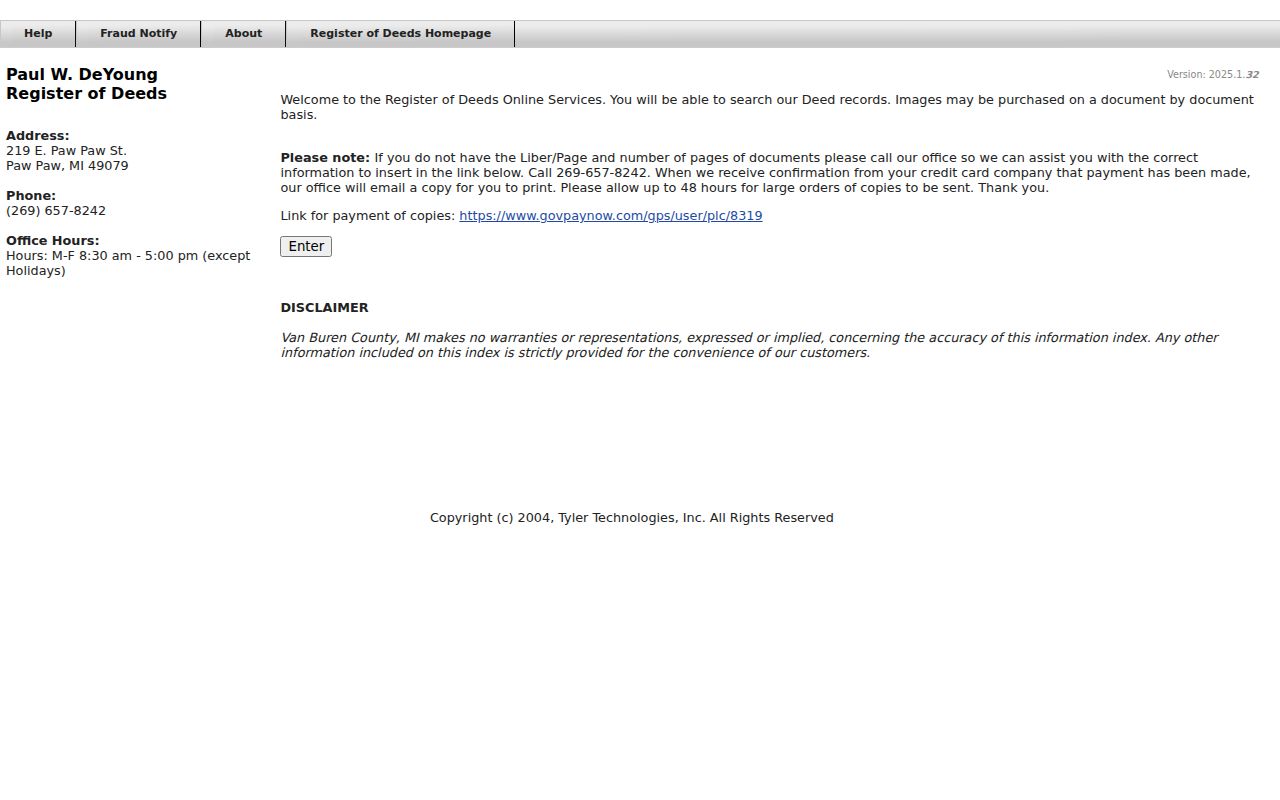
An index hit only locates an instrument. The document itself reveals the land, the parties, the deed type, and any reservations affecting the chain.
Watch the Van Buren County Liber 924 Split
The Register splits its copy workflow at one book boundary. Requests for Liber 924 or lower follow the county's older-copy and GovPay route. Liber 925 or higher takes the newer workflow. The split matters most when consecutive deeds straddle the line. Record liber and page exactly as shown. If an image will not open online, give those references to the Register. Reach them by phone, mail, or at the counter. Never assume an older deed is missing. Note: A failed online image signals the older-copy workflow, not a gap in the recorded chain.
Reconstruct Van Buren County's Deed Chain Backward
Treat each grantor as the next subject. Log every transfer in its own row so a skipped generation, a different deed type, or a changed legal description stays visible.
| Transfer date | Grantor to grantee | Deed type | Instrument or liber/page |
|---|---|---|---|
| Newest recording | Prior owner to current grantee | As recorded | Save exact locator |
| Earlier recording | Earlier owner to that prior owner | As recorded | Match land description |
| Repeat | Continue one grantor at a time | Note warranty, quitclaim, fiduciary, or other form | Flag unexplained breaks |
- Find the current grantee's latest acquisition deed for the subject description.
- Record the grantor, date, deed type, instrument number or liber/page, and exact land wording.
- Search that grantor as an earlier grantee and verify the same land.
- Repeat until the portal ends, then carry the last locator to the Register's older books and copy channels.
- Grantor / grantee
- The conveying party and the party receiving the recorded interest.
- Chain of title
- The ordered series of instruments affecting the same land.
- Reverse index
- An index organized to help trace parties on the conveying side.
- Warranty / quitclaim deed
- Different conveyance forms whose legal effect must be read from the instrument.
- Legal description
- The land identity that remains useful when a street address changes.
Use Van Buren County Assessment Rolls as a Second Trail
The Archives of Michigan county guide lists assessment-roll material spanning 1838 to 1920, with additional local series. A roll names a person, land, and value. That can narrow a gap between deeds. It cannot prove title. Consult the Archives county guides, then request material in advance for the reading room or ask staff about access.

The archive route shines when labels drift. An obsolete township name or old assessment description that no longer matches today's parcel card often resolves only in the original series.
Match Former Van Buren County Owners to Historic Maps
Van Buren County plat books date from 1873, 1895, 1906, and 1912. They supply dated map context for ownership research. The 2023 ownership and aerial plat book serves modern orientation. Historic survey field books describe PLSS corners and witness marks. LARA and the Register hold recorded subdivision-plat routes. Review the county's digitized historic plat books.
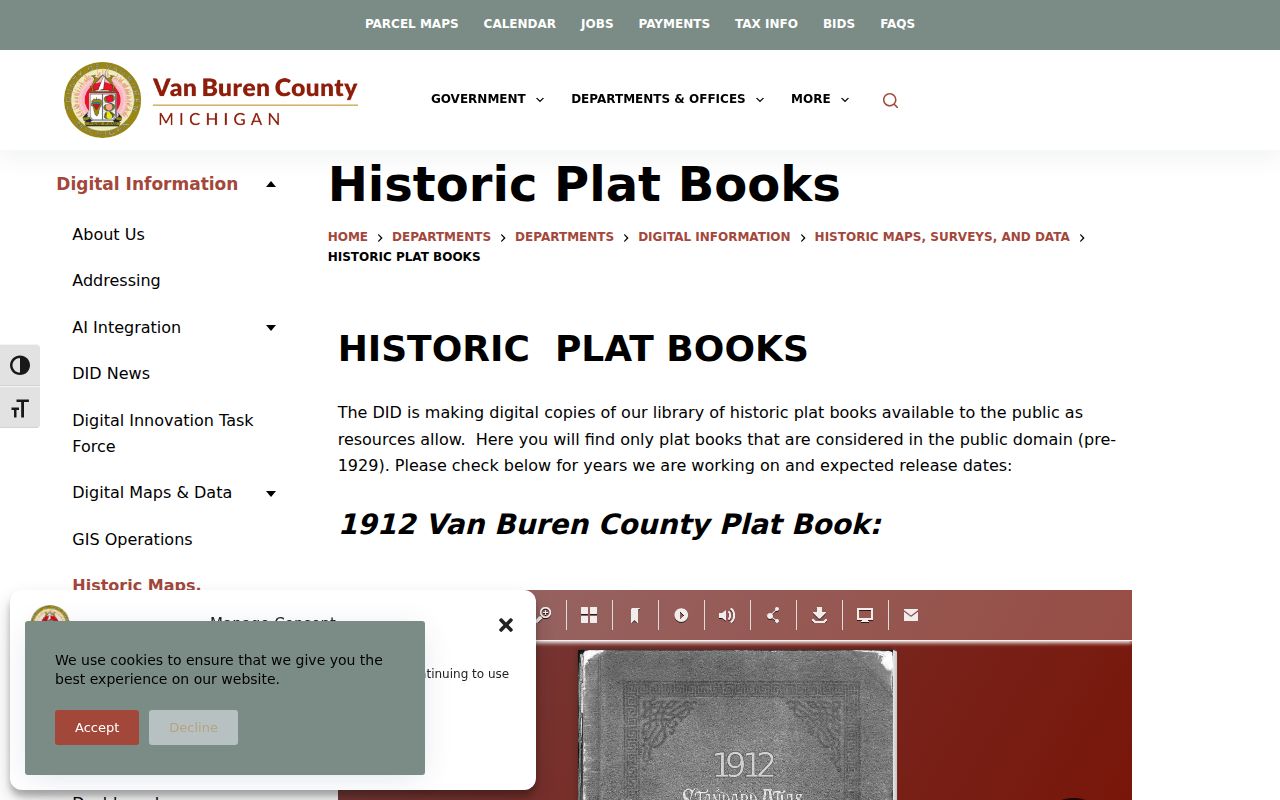
A printed owner name marks one date only. Test it against the deed chain rather than leaping over missing transfers.
Explain Van Buren County Name Changes and Estate Transfers
A tidy buyer-and-seller sequence can snap without warning. Land often moved through probate, survivorship, a personal representative, or a marriage-related name change rather than an ordinary sale. Search the name variants. Read the deed type closely. Consult the probate or circuit file only when an identifiable case supports the transfer. The County Clerk routes court information through MiCOURT and local court links. MiCOURT is a lead, not the case file. A court order affecting land may still require a later deed or recorded instrument to complete the property-record trail.
Let Van Buren County Newspapers Supply Leads, Not Proof
The volunteer newspaper index packs coded real-estate-transfer entries alongside community references. Underlying newspapers arrive through microfilm routes. A single notice can surface a former name, an estate, a sale, or a legal-description phrase worth testing in the deed books. The Van Buren newspaper-index key explains its fields and codes. Library of Michigan holdings and local repositories can supply the full item. A clipping never substitutes for the recorded conveyance.
Build a Four-Layer Van Buren County History Check
A strong historical file layers four sources. Compare the current BS&A parcel card, the Parcel Viewer polygon, an original or historic plat, and the Register of Deeds instrument. The parcel card gives today's identifier and roll name. GIS supplies location, sections, nearby features, and imagery, while the old map shows how the tract was described at a prior date and the deed records the transfer itself. If all four align, the conclusion holds. One conflict changes the task. Investigate the date, municipal label, parcel split, name form, and legal description before touching the timeline. Never erase a difference just to finish the story. The unresolved gap is often the most useful finding, pointing the next counter, archive, or deed-book search.
Keep a Van Buren County Former-Owner Chain Log
Log every detail as you work. Record the searched name and each name variant. Note whether the party acted as grantor or grantee. Add the recording date, deed type, instrument or liber/page reference, and legal description. Note the source channel you used. A compact chain log like this exposes duplicated names. It also reveals gaps in Van Buren County deed records before guesswork fills them in. It keeps your property search honest when the trail grows long.
Treat a step as provisional when it rests on a single source. That may be a tax roll, a plat-book label, one newspaper line, or a probate lead. That owner earns a place in the deed chain only after a recorded instrument or other title-grade evidence appears. The document must explain the transfer. Anything less is a lead, not a link.
Know How Far Van Buren County Ownership Records Go
No online start year is posted. The Tyler portal does not state how far back its index of Van Buren County property records reaches. For older deeds, ask the Register of Deeds. Liber and page questions land there too. Beyond that office, the Archives, historic plat books, land patents, survey notes, probate series, tax rolls, and newspapers add depth the portal lacks. The county's Digital Information tools bundle parcel history with original land patents and survey material. A 2025 Hartford Library presentation walked about 50 attendees through combining the Parcel Viewer, parcel history, patents, plats, and mid-1800s notes. That method keeps modern and historic identifiers together.
Online cutoff unknown. Do not invent a starting year. Continue older Van Buren County owner research through the Register, archives, and deed books.
Former-owner data serves Van Buren County house history, estate work, purchase diligence, and legitimate land research. A plat name is only a lead. The same caution applies to a tax roll entry. Each transfer in the chain must be backed by a deed, since name variants, estate roles, and old jurisdiction labels can hide prior owners. Patience pays off. Never use past ownership facts or a living person's mailing details to stalk, target, or harass anyone. That chain is research, not a title opinion.