
Identify Who Owns a Van Buren County Property
The path runs in stages. Start with the place, then the parcel, then the tax roll, then the recorded deed that settles title, keeping a map label, taxpayer field, or occupant from ever being mistaken for verified ownership.
- Search the address in Van Buren County BS&A Online and save the parcel number.
- Read the Owner/Taxpayer field as a dated assessment-roll entry.
- Search that name in the Register of Deeds index and identify the newest deed for the same legal description.
- If an entity is named, cross-check its filing in Michigan's MiBusiness Registry rather than guessing at a person.
Trace the Van Buren County BS&A Owner Field
BS&A offers three search modes. Address, Name, and Parcel Number all work. Spelling or address trouble can slow a Van Buren County property search down. A result opens Property Information, Tax Information, and Delinquent Tax Information. Jump links lead deeper. From any result, capture the parcel number, municipality, owner label, situs, and any mailing information shown. Grab the legal-description link too. The official property portal is the starting point for the county roll.
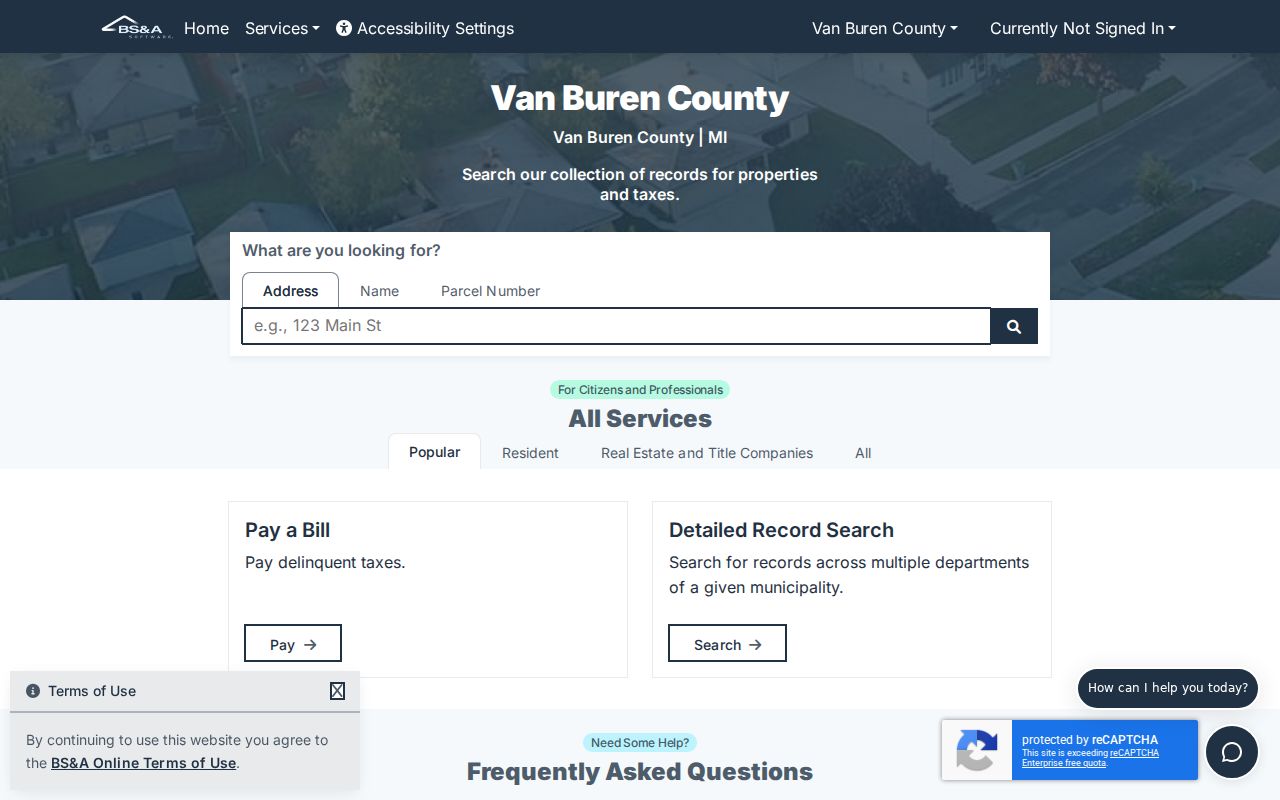
Even so, the owner field stays a roll snapshot.
Follow a Van Buren County Entity Name Carefully
Sometimes an LLC, corporation, trust, estate, or survivorship phrase stands where a personal name should be. Search the entity exactly as printed. Michigan's MiBusiness Registry can clarify a business filing, and the County Clerk's assumed-name index can supply a local filing lead. Neither changes the deed's grantee.
- Owner of record
- The name carried on the assessment roll at the time viewed.
- Grantee
- The party receiving an interest in a recorded deed.
- Situs address
- The property's location, which may differ from the owner's mail address.
- Title
- The legal ownership interest, not a conclusion supplied by a portal search.
Compare Van Buren County Ownership Sources
No single screen settles every ownership question. Use the roll for a practical current name, the deed index for the recorded transfer, and the GIS map to confirm the tract.
| Source | Owner Info It Gives | Access |
|---|---|---|
| BS&A assessment roll | Owner/taxpayer and mailing fields | Free web search; local assessor fallback |
| Register of Deeds | Latest deed grantee and legal description | Tyler index; registration and paid images; office copy route |
| MiBusiness Registry | Michigan entity filing | Free state search |
| Parcel Viewer | Owner label tied to mapped parcel | Free viewer; reference only |
When a web path stalls, phone the municipality's assessor using the county assessor list. The Register counter in Paw Paw is another option. A focused Michigan FOIA request works too. The county publishes no fixed roll-refresh interval for the owner field, so same-day transfer updates are never guaranteed.
Resolve a Stale Van Buren County Property Owner Field
Van Buren County publishes no fixed refresh interval for the owner field. A recent sale explains the trouble. A new deed may land before the roll updates. Don't pick a winner by intuition. Save the roll date, then search the Register of Deeds under the displayed owner, the expected buyer, a trust, a spouse, or entity variants.
Match the legal description. A lookalike street address can mislead. The deed index holds same-name people plus instruments touching other land. Open the newest likely deed and note its grantee and recording date. If it is newer and matches the tract, treat the roll as pending or stale and contact the correct city or township assessor.
Local rolls belong to city and township assessors. County Equalization checks consistency across them. It cannot replace the local correction channel, and the county's assessor list, arranged by municipality, routes each roll question to the right office.
Separate Van Buren County Taxpayer, Mail, and Situs Fields
Copy Owner/Taxpayer, mailing address, and situs into separate notes. Each field answers a different question. The owner label names the roll party, the mailing field shows where tax bills go, and the situs marks the parcel. None proves the party lives there.
The split matters for vacant land, second homes, farms, businesses, and trusts. An out-of-state mailing address fits a Van Buren County parcel just fine. Mail at the situs proves no title. Anchor the work to the parcel number and legal description.
Michigan's Address Confidentiality Program gives eligible participants a substitute address. Do not search around that safety protection. Continue with the lawful owner and deed evidence instead.
Trace a Van Buren County Estate or Survivorship Owner
An estate, trust, or survivorship phrase explains many mismatches. The current roll and an older purchase deed refuse to line up neatly. Blame the vesting language on the newest instrument. When probate is relevant, the County Clerk and Probate Court records can supply a case lead, though that display is never the recorded property transfer itself.
MiCOURT says so plainly. Its online information never replaces the official court file, and some categories are omitted or filtered. Use it only to spot a case. Request the file through the proper clerk. Any probate order, personal-representative deed, or later instrument recorded against the land belongs back at the Register of Deeds.
A death record, a probate order, and a deed are separate records. Together they explain the sequence. None permits publishing sensitive family details unrelated to the property.
Monitor Van Buren County Ownership Without Overstating a Signal
Van Buren County gives owners a real reason to watch new recordings. The Register offers a Fraud Notify signup for alerts. An April 2026 Sheriff's release described alleged multiple liens in an Almena Township case. The case was tied to a terminated sale. One troubling filing does not make every unfamiliar lien or name fraudulent. It does show why prompt review matters. Keep the parcel number and legal description close at hand. Search owner and entity name variants. Retrieve any unfamiliar instrument. Compare the land wording line by line. A new deed, a changed tax mailing address, and an added lien are three distinct signals. Treat each one on its own. Ask the Register for help reading a document. Bring suspected criminal conduct to law enforcement. A lawyer can explain what an instrument actually does to ownership. The Register's online system may require registration and charges fees for images. If the portal stalls, direct copy assistance at 269-657-8242 remains available. Mail or counter service also remain options. The older-liber payment path is still offered too. Access friction is never proof that an owner changed.
Match the Van Buren County Legal Description Before Naming an Owner
A street address is only a lead. The legal description is what identifies the land in every recorded instrument. Platted parcels lean on lot, block, subdivision, and recording references. Unplatted land may carry section, township, range, metes and bounds, or other calls. Compare enough of that wording. That rules out a same-name mix-up or a nearby parcel error. The Parcel Viewer can add Sections and Subdivisions layers to help interpret a description. The county's original-plat workflow can open a subdivision map. Those tools confirm geography, not people. The Register holds the underlying deed. For the named grantee and the estate conveyed, read it. Maybe the address, parcel number, owner field, and legal description disagree. Treat that conflict as your answer. Recheck the municipal unit first. Then look at recent address updates, parcel history, and the newest recording. Ask the local assessor about its roll. Ask the Register about the recorded instrument instead of smoothing over the mismatch.
Use Van Buren County Owner-Search Fallbacks
BS&A sometimes returns nothing for an address. Try the parcel number from the Parcel Viewer instead. A reasonable owner-name variant can also work. If the Tyler portal blocks progress, register as required. Or call the Register's direct copy and search line at 269-657-8242. Staff can help locate a known instrument or an older liber reference. The county does not perform title or easement searches. Each local assessor runs its own roll inspection and correction channel by municipality. The Register provides online, phone, mail, and counter access. Michigan FOIA serves as a fallback for an identifiable public county record. It covers records not available through routine channels. FOIA is not a way to make the county decide ownership.
Limit a Van Buren County Ownership Conclusion
A public owner search proves less than people hope. It cannot show occupancy, beneficial interests behind a trust, unrecorded claims, or a complete title chain. Michigan's Address Confidentiality Program can also substitute an address for an eligible participant, and missing mail data is never permission to chase private details.
Lawful use. Use Van Buren County owner records for legitimate property diligence. Never use public data to harass, intimidate, or harm a person.
Title-grade certainty calls for the instruments themselves. Pull the documents behind any index entry through the Van Buren County Register of Deeds index, and bring in qualified help before you act. An index hit is not a title opinion. The Van Buren County deed records guide walks through that proof route in plain terms.